


Budget 2026 – Personal Income Tax Rates: New Regime vs Old Regime Decoded
Introduction
The Union Budget 2026, presented by Finance Minister Nirmala Sitharaman on February 1, 2026, has generated considerable discussion about personal income tax rates. However, here’s the straightforward truth: there are no changes to income tax slab rates under either the new or old tax regime for FY 2026-27 (Assessment Year 2026-27).
This might sound like a disappointment at first, but understanding why the government chose continuity—and what it means for your tax planning—is crucial. In this article, we decode both tax regimes, compare them head-to-head, and help you determine which one makes sense for your financial situation.
Quick Overview: New Regime vs Old Regime
Before diving into slabs and rates, let’s establish the foundational difference:
| Aspect | New Tax Regime | Old Tax Regime |
|---|---|---|
| Default Regime | Mandatory from FY 2023-24 onwards for most taxpayers | Optional; must be explicitly claimed |
| Deductions Allowed | Limited (only 123-154 under new Income Tax Act 2025) | Extensive (80C, 80D, 80E, 80U, etc.) |
| Who Benefits Most | Salaried individuals with minimal investments | Self-employed, business owners, high-deduction earners |
| Adoption Rate (FY 2025-26) | 72% of individual taxpayers | 28% of individual taxpayers |
| Government Direction | Being pushed; likely to become only option in future | Gradually phased out; sunset likely by 2028-29 |
Now, let’s examine the actual rates for FY 2026-27:
New Tax Regime – FY 2026-27 Income Tax Slabs
The new regime introduces a simpler, flatter rate structure without complicated deduction calculations:
Slab Rates (Default Under Section 115BAC)
| Income Bracket | Tax Rate | Applicable From |
|---|---|---|
| Up to ₹4,00,000 | Nil (No Tax) | AY 2026-27 |
| ₹4,00,001 to ₹8,00,000 | 5% | AY 2026-27 |
| ₹8,00,001 to ₹12,00,000 | 10% | AY 2026-27 |
| ₹12,00,001 to ₹16,00,000 | 15% | AY 2026-27 |
| ₹16,00,001 to ₹20,00,000 | 20% | AY 2026-27 |
| ₹20,00,001 to ₹24,00,000 | 25% | AY 2026-27 |
| Above ₹24,00,000 | 30% | AY 2026-27 |
Key Observation: These rates are identical to FY 2025-26. The government has chosen to hold ground rather than offer further relief.
Understanding the “Effective Tax-Free Income Limit”
Here’s where the new regime becomes interesting for middle-class taxpayers:
Section 87A Rebate (₹60,000): Under the new regime, you get a flat ₹60,000 rebate on tax liability if your total income does not exceed ₹12,00,000.
Practical Impact:
Let’s calculate the tax for someone earning ₹10,00,000 (10 lakh) under the new regime:
- Income up to ₹4L: ₹0 (nil slab)
- Income ₹4L to ₹8L (₹4L): ₹4L × 5% = ₹20,000
- Income ₹8L to ₹10L (₹2L): ₹2L × 10% = ₹20,000
- Subtotal Tax: ₹40,000
- Less: Section 87A Rebate: -₹60,000
- Final Tax Liability: ₹0 (rebate covers entire tax)
Result: A person earning ₹10 lakh pays zero income tax under the new regime.
Standard Deduction Bonus (Salaried Only): If you’re a salaried employee, you also get a ₹75,000 standard deduction on salary income. This effectively raises your tax-free limit to ₹12,75,000 before considering rebate.
Simplified Rate Option (Old Regime Opt-Out)
For those who choose not to use the new regime and want a simpler old regime structure, the Budget 2026 provides alternative simplified rates under Part I-A of the First Schedule:
| Income Bracket | Tax Rate |
|---|---|
| Up to ₹2,50,000 | Nil |
| ₹2,50,001 to ₹5,00,000 | 5% |
| ₹5,00,001 to ₹10,00,000 | 20% |
| Above ₹10,00,000 | 30% |
These are lower than the standard new regime rates for incomes between ₹10L-₹24L, making them attractive for certain taxpayers.
Old Tax Regime – FY 2026-27 Income Tax Slabs
The old regime continues to offer extensive deductions, making it valuable for self-employed professionals, business owners, and high-deduction earners. However, it comes with higher base tax rates in the absence of deductions.
Standard Old Regime Rates
| Income Bracket | Tax Rate | Applicable From |
|---|---|---|
| Up to ₹2,50,000 | Nil (No Tax) | AY 2026-27 |
| ₹2,50,001 to ₹5,00,000 | 5% | AY 2026-27 |
| ₹5,00,001 to ₹10,00,000 | 20% | AY 2026-27 |
| Above ₹10,00,000 | 30% | AY 2026-27 |
Critical Point: These rates are significantly higher than the new regime for incomes between ₹8L-₹24L. However, the old regime allows massive deductions that can offset this rate disadvantage.
Age-Based Exemptions (Old Regime)
Senior citizens receive preferential exemption limits:
For Individuals Aged 60–80 Years
| Income Bracket | Tax Rate |
|---|---|
| Up to ₹3,00,000 | Nil |
| ₹3,00,001 to ₹5,00,000 | 5% |
| ₹5,00,001 to ₹10,00,000 | 20% |
| Above ₹10,00,000 | 30% |
Benefit: An additional ₹50,000 exemption compared to younger taxpayers.
For Individuals Aged 80+ Years (Super Senior Citizens)
| Income Bracket | Tax Rate |
|---|---|
| Up to ₹5,00,000 | Nil |
| ₹5,00,001 to ₹10,00,000 | 20% |
| Above ₹10,00,000 | 30% |
Benefit: ₹5 lakh exemption limit—the most generous under the old regime.
Surcharge & Health-Education Cess (Applicable to Both Regimes)
Both regimes are subject to surcharge and cess, which increase the effective tax rate for high earners:
Surcharge Structure for FY 2026-27
| Income Level | Surcharge Rate | Special Notes |
|---|---|---|
| Up to ₹50 lakh | Nil | No surcharge for incomes up to ₹50 lakh |
| ₹50 lakh – ₹1 crore | 10% of tax | For investment income (dividends, capital gains), capped at 15% surcharge |
| ₹1 crore – ₹2 crore | 15% of tax | Capped at 15% for investment income |
| ₹2 crore – ₹5 crore | 25% of tax | Different cap: 15% for investment income only |
| Above ₹5 crore | 25% of tax (capped from prior 37%) | Major relief: Ordinary income surcharge now capped at 25%, down from 37% |
What is Surcharge? Surcharge is an additional tax levied on your income tax, not on your income. It applies only when your income exceeds ₹50 lakh.
Example: A self-employed CA earning ₹3 crore:
- Base income tax (30% slab): ₹3 crore × 30% = ₹90 lakh
- Surcharge (25% of ₹90L): ₹22.5 lakh
- Total tax before cess: ₹90L + ₹22.5L = ₹1,12.5 lakh
- Effective tax rate: 37.5% (without cess)
Health and Education Cess – 4% (Universal)
On top of income tax + surcharge, a 4% Health and Education Cess is levied. This applies to all taxpayers, regardless of income level.
Calculation: Cess = (Income Tax + Surcharge) × 4%
Revised Total Tax Rate Example (continuing the CA example above):
- Tax + Surcharge: ₹1,12.5 lakh
- Cess (4%): ₹1,12.5L × 4% = ₹4.5 lakh
- Grand Total Tax: ₹1,17 lakh
- Effective Tax Rate: ~39%
Head-to-Head Comparison: Which Regime Should You Choose?
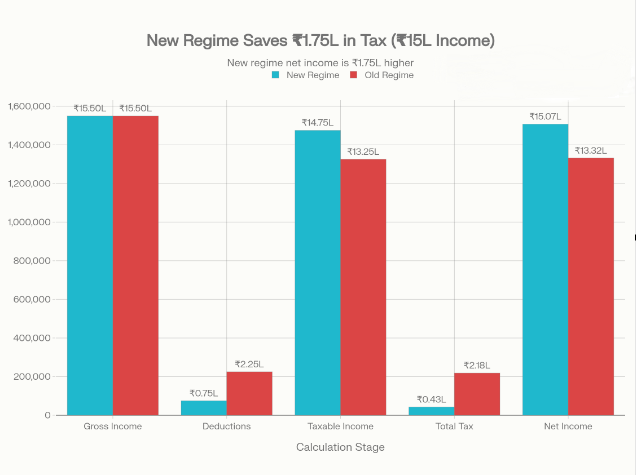
Scenario 1: Salaried Employee Earning ₹15 Lakh
Income Breakdown:
- Salary: ₹15 lakh
- Interest on Savings: ₹50,000
- Total Income: ₹15.5 lakh
Under New Regime:
- Standard Deduction: ₹75,000 (on salary only)
- Taxable Income: ₹15.5L – ₹75K = ₹14.75L
- Tax Calculation:
- ₹0-₹4L: ₹0
- ₹4L-₹8L: ₹4L × 5% = ₹20,000
- ₹8L-₹12L: ₹4L × 10% = ₹40,000
- ₹12L-₹14.75L: ₹2.75L × 15% = ₹41,250
- Subtotal: ₹1,01,250
- Less: Section 87A Rebate: ₹0 (income exceeds ₹12L limit)
- Tax Liability: ₹1,01,250
- Plus Cess (4%): ₹4,050
- Total Tax: ₹1,05,300
Under Old Regime:
- Deductions available:
- Standard Deduction: ₹75,000
- PPF Investment: ₹1.5 lakh (assumed)
- Health Insurance: ₹25,000 (assumed)
- Total Deductions: ₹2,25,000
- Taxable Income: ₹15.5L – ₹2.25L = ₹13.25L
- Tax Calculation:
- ₹0-₹2.5L: ₹0
- ₹2.5L-₹5L: ₹2.5L × 5% = ₹12,500
- ₹5L-₹10L: ₹5L × 20% = ₹1,00,000
- ₹10L-₹13.25L: ₹3.25L × 30% = ₹97,500
- Subtotal: ₹2,10,000
- Plus Cess (4%): ₹8,400
- Total Tax: ₹2,18,400
Winner: New Regime (saves ₹1,13,100 per year for this salaried individual)
Scenario 2: Self-Employed Professional (CA/Doctor) Earning ₹25 Lakh
Income Breakdown:
- Professional Fees: ₹25 lakh
- Interest on Fixed Deposits: ₹1 lakh
- Total Income: ₹26 lakh
Under New Regime:
- No deductions allowed (new regime doesn’t permit professional expense deductions under Section 30, 37, etc.)
- Taxable Income: ₹26 lakh
- Tax Calculation:
- ₹0-₹4L: ₹0
- ₹4L-₹8L: ₹4L × 5% = ₹20,000
- ₹8L-₹12L: ₹4L × 10% = ₹40,000
- ₹12L-₹16L: ₹4L × 15% = ₹60,000
- ₹16L-₹20L: ₹4L × 20% = ₹80,000
- ₹20L-₹24L: ₹4L × 25% = ₹1,00,000
- ₹24L-₹26L: ₹2L × 30% = ₹60,000
- Subtotal: ₹3,60,000
- Plus Cess (4%): ₹14,400
- Total Tax: ₹3,74,400
Under Old Regime:
- Deductions available:
- Professional Expenses (estimated): ₹3 lakh
- Section 80C (PPF, LIC, ELSS): ₹1.5 lakh
- Section 80D (Health Insurance): ₹25,000
- Section 80U (NPS): ₹50,000
- Total Deductions: ₹5.25 lakh
- Taxable Income: ₹26L – ₹5.25L = ₹20.75L
- Tax Calculation:
- ₹0-₹2.5L: ₹0
- ₹2.5L-₹5L: ₹2.5L × 5% = ₹12,500
- ₹5L-₹10L: ₹5L × 20% = ₹1,00,000
- ₹10L-₹20.75L: ₹10.75L × 30% = ₹3,22,500
- Subtotal: ₹4,35,000
- Surcharge (on ₹35K surplus): Nil (below ₹50L threshold for surcharge)
- Plus Cess (4%): ₹17,400
- Total Tax: ₹4,52,400
Winner: New Regime (saves ₹78,000 per year even without professional deductions!)
Key Insight: For many self-employed professionals, the new regime’s lower rates outweigh the loss of deductions—a paradigm shift from traditional tax wisdom.
Scenario 3: Business Owner Earning ₹60 Lakh with High Deductions
Income Breakdown:
- Business Profit: ₹60 lakh
- Other Income: ₹0
- Potential Deductions: ₹15 lakh (rent, depreciation, employee benefits, NPS, etc.)
Under New Regime:
- No deductions; Taxable Income: ₹60 lakh
- Tax Calculation:
- ₹0-₹4L: ₹0
- ₹4L-₹8L: ₹20,000
- ₹8L-₹12L: ₹40,000
- ₹12L-₹16L: ₹60,000
- ₹16L-₹20L: ₹80,000
- ₹20L-₹24L: ₹1,00,000
- ₹24L-₹60L: ₹36L × 30% = ₹10,80,000
- Subtotal: ₹12,80,000
- Surcharge (10% of ₹12.8L for income ₹50-60L): ₹1,28,000
- Tax + Surcharge: ₹14,08,000
- Plus Cess (4%): ₹56,320
- Total Tax: ₹14,64,320
- Effective Tax Rate: 24.4%
Under Old Regime:
- Taxable Income: ₹60L – ₹15L = ₹45 lakh
- Tax Calculation:
- ₹0-₹2.5L: ₹0
- ₹2.5L-₹5L: ₹12,500
- ₹5L-₹10L: ₹1,00,000
- ₹10L-₹45L: ₹35L × 30% = ₹10,50,000
- Subtotal: ₹11,62,500
- Surcharge (10% of tax for ₹50-60L of gross income; applied to tax on income up to ₹50L): Nil (because taxable income ₹45L < ₹50L surcharge threshold)
- Plus Cess (4%): ₹46,500
- Total Tax: ₹12,09,000
- Effective Tax Rate: 20.2%
Winner: Old Regime (saves ₹2,55,320 per year)
Key Insight: For businesses with genuine deductions, the old regime remains superior—but the gap is narrowing.
Decision Framework: How to Choose Your Regime?
Use this practical decision tree:
textSTART: Choose Your Tax Regime

1. Are you a salaried individual with annual income < ₹20 lakh?
   ├─ YES → Choose NEW REGIME (save ₹50,000-₹2,00,000 annually)
   └─ NO → Go to Q2

2. Do you have significant deductions under Section 80C, 80D, 80E, etc.?
   ├─ YES (₹3+ lakh annual deductions) → Analyze both; likely OLD REGIME
   ├─ MAYBE (₹1.5-₹3 lakh deductions) → Run calculation; could be either
   └─ NO → Go to Q3

3. Is your income above ₹50 lakh (subject to surcharge)?
   ├─ YES → OLD REGIME likely better (deductions reduce surcharge base)
   └─ NO → NEW REGIME likely better (simpler, lower rates)

4. Do you have business/professional income with high expenses?
   ├─ YES → OLD REGIME almost certainly better (claim business deductions)
   └─ NO → NEW REGIME recommended (avoid deduction limitations)

END: Review with CA; run actual calculations for 2-3 year average income
Special Considerations for FY 2026-27
1. Transition to New Income Tax Act 2025
Effective April 1, 2026, the new Income Tax Act 2025 comes into force. Key changes:
- Deduction sections renumbered (Section 80C → Section 123, etc.)
- New deduction structure: Sections 121-154
- Assessment Year → Tax Year terminology shift
- Impact on your regime choice: Ensure your CA updates return software and calculations for new act sections by April 1
2. No Increase in Deduction Limits
Many expected Budget 2026 to increase:
- Section 80C from ₹1.5 lakh to ₹2 lakh or more
- Section 24(b) home loan interest from ₹2 lakh to ₹3-5 lakh
These were NOT increased. If planning reliance on these, do so carefully.
3. Old Regime Phase-Out Signal
With 72% of taxpayers on new regime, the government is preparing for old regime sunset around 2028-29. If you’re currently on old regime:
- Lock in benefits NOW
- Accelerate deductions (invest in Section 80C, pay health insurance premiums, etc.)
- Gradually plan migration to new regime for future years
4. Section 87A Rebate Limitation
The ₹60,000 rebate under Section 87A is available only under new regime and applies only if total income does not exceed ₹12 lakh. Once you cross ₹12 lakh, the rebate is gone entirely—no phase-out.
Implication: Two individuals earning ₹11.99 lakh and ₹12.01 lakh have vastly different tax outcomes. Be aware of this cliff.
Practical Tax Planning Tips for FY 2026-27
Tip 1: Analyze Both Regimes Every Year
Regime choice should not be “sticky”—review annually. Your optimal regime can change based on:
- Changes in investment patterns
- Variation in income levels
- Life events (retirement, business closure, marriage)
Tip 2: Front-Load Old Regime Deductions (If Applicable)
If you’re on old regime, maximize Section 80C investments before March 31, 2026:
- PPF contribution: ₹1.5 lakh
- ELSS investment: ₹1.5 lakh (if not already utilizing Section 80C cap)
- LIC/Endowment insurance: Adjust to max-out ₹1.5 lakh
Each rupee deducted saves up to 30% tax (plus cess); this is guaranteed return.
Tip 3: Maintain Detailed Records (New Act Emphasis)
The new Income Tax Act 2025 places greater emphasis on electronic verification and evidence-based claims. Maintain:
- Digitized receipts for health insurance premiums
- Investment confirmations (PPF, ELSS, NPS)
- Rent receipts and municipal tax payments
- Mortgage statements (for Section 24(b))
Tip 4: Plan for Standard Deduction Increase (Likely)
If you’re salaried, expect Standard Deduction to increase from ₹75,000 to ₹1,00,000+ in Budget 2027 or 2028. Plan salary components accordingly:
- Request employer to classify more income as salary (vs. allowances) to maximize standard deduction benefit
Tip 5: Use Revised Return Window Wisely
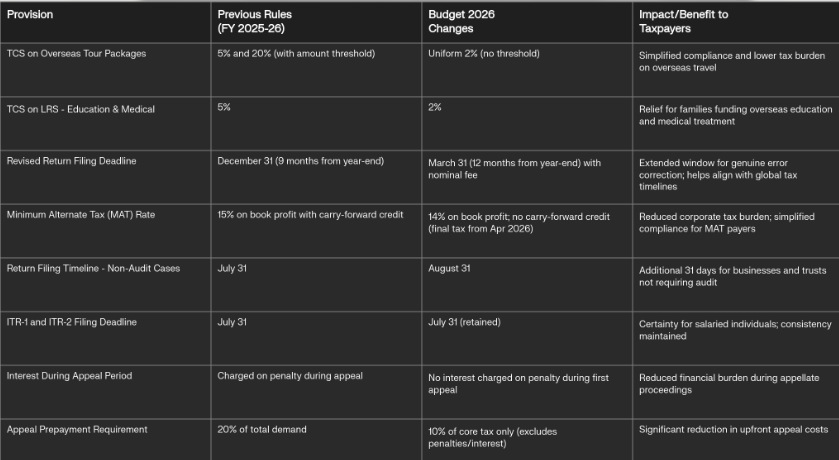
Budget 2026 extended revised return deadline to March 31 (from December 31). This enables:
- Correcting income classification errors after receiving international tax documents
- Adjusting foreign tax credits post-filing
- Fixing deduction calculations after completing investments
Action: File original return by July 31; use Mar 31 window for refinement if needed.
Common Myths Debunked
Myth 1: “New Regime Has No Deductions”
Reality: New regime allows several deductions:
- Standard Deduction for salaried employees (₹75,000)
- Section 129 (Education Loan Interest) – no limit
- Section 139 (Life Insurance Premium for specified insureds)
- New Act Section 127 (Disability Dependent Allowance)
The restriction is mainly on business expense deductions, not all deductions.
Myth 2: “Old Regime is Always Better for Self-Employed”
Reality: New regime’s lower rates (30% top slab vs. 30% old regime, but applied to lower income bases due to rate progressivity) can outweigh deduction benefits for many professionals. Run calculations—don’t assume.
Myth 3: “Budget 2026 Slashed Tax Rates”
Reality: No rate changes. The government continued FY 2025-26 rates unchanged. The “relief” came through TCS reductions, procedural simplifications, and surcharge caps for ultra-high earners (above ₹5 crore).
Myth 4: “Surcharge Only Affects Very Rich People”
Reality: Surcharge applies at ₹50 lakh income threshold. For a ₹50.5 lakh earner, a 10% surcharge on tax can add ₹3,000-₹5,000 to the bill. It affects upper-middle-class professionals.
Conclusion & Action Items
For FY 2026-27:
✅ Most salaried individuals: Choose new regime; enjoy lower rates and simpler compliance.
✅ High-deduction earners (business owners, senior professionals): Run detailed calculations; old regime may still be superior.
✅ Anyone earning above ₹50 lakh: Be aware of surcharge; consider tax-efficient investments (NPS, health insurance, education) to offset.
✅ Senior citizens (60+): Review age-based exemption limits under old regime; may offer advantages.
✅ All taxpayers: Prepare for April 1, 2026, transition to new Income Tax Act; ensure your CA has updated return software.
✅ Old regime users: Start planning gradual migration; accelerate deduction lock-in before phase-out.

FCA, CWM (AAFM-US), CBV, CIFRS, R-ID, B.COM (H), RV* (IBBI)
Practising Chartered Accountant in Delhi NCR Since 2011.